Are you planning a visit to Mantua? Do you want to know more about this Renaissance city? Contact us for a guided tour and discover through our professional services the fascinating Palaces and Squares, with scenes of one of the most brilliant seasons of Italian History.
Palazzo Te is now pretty completely open. The only room still closed is the “Room of the Sun and the Moon”.
The Ducal Palace, where the restorers are now working, will be closed for an indefinite period of time. Anyway some spaces of the Palace have been reopened on June 16th:
The Private Rooms of Isabella d’Este (“Scalcheria”, “Studiolo”, “Grotta” and “Secret Garden”) – entrance from Piazza Sordello.
The Botanic Garden (“Giardino dei Semplici”) and the “Rustica” (“Chamber of the Fishes”, “Cabinet of Orpheus”, “Chamber of Jupiter”, “Chamber of the Four Pillars”, “Chamber of Bacchus”, “Chamber of the Fruits” and the “Chamber of the two Columns”, with an exhibition of Ancient Greeks Marbles within ) – entrance from Piazza Paccagnini.
A third of the Ducal Palace is now reopened: discover more reading this post.
May 29th - The Mayor of Mantua and the Director of Palazzo Te have checked through the Museum today at 16.30. They described falls of rubbles, of stuccoes and of frescoed plaster, and also vertical cracks in the North Wing: the Loggia of the Muses, the Exterior Loggia, the Hall of the Horses and the Chamber of Cupid and Psyche have been damaged.
Due to the earthquake Palazzo Te is closed indefinitely.
Follow us on our blog and on Twitter (@VisitMantua) to
be update about this topic.
A third of the Ducal Palace is now reopened: discover more reading this post.
29th
May – New Earthquake in Mantua. The lantern of the bell-tower of the Palatine
Basilica of Santa Barbara, the Palace
Chapel for the Gonzagas, has collapsed. The Palatine Church of Santa Barbara was
commissioned by the Duke Guglielmo Gonzaga and built between 1562 and 1572 by
Giovan Battista Bertani. The bell-tower, with its characteristic lantern, was
one of the most prominent landmarks of the skyline of the city.
May 20th 2012 - Earthquake in Northern Italy: the Ducal Palace of Mantua has been damaged. About 40 centimeters squared (16 inches squared) with frescoes and stucco have been destroyed in the Gallery of the Marbles (aka Gallery of the Months). Mantegna's frescoes are unscathed. Many cracked ceilings and many horizontal cracks, mostly in the New Court. The Museum is closed indefinitely.
Palazzo Te is unhurt, and open as usual.
A third of the Ducal Palace is now reopened: discover more reading this post.
“Art challengesTechnology. AndTechnology inspiresArt”( John Lasseter).
This is the idea ruling the exhibition about
the creative PIXAR talent, revealing and
investigating the making of the highly acclaimed animated films we have come to
know so well.
Starting in the mid 1980s,
an exceptional and inspiring trio of innovators, John Lasseter, Ed Catmull and
Steve Jobs, combined their gifts in art, science and business to launch a whole
new approach to making 3-D animated films and ended up reshaping the face of
filmmaking forever. Pixar Animation Studios was formed in 1986 in California,
USA. It combines creative and technical artistry to create original stories in
the medium of computer animation. Pixar made history in 1995 with Toy Story,
the first fully computer animated feature film.
The exhibition in Palazzo
Te features over 500 works by the artists at Pixar Animation Studios, including
drawings, paintings, and sculptures that illustrate the creative process and
craftsmanship behind Pixar’s wildly successful computer-animated films. The
show spans all Pixar’s feature films (Toy Story, A Bug’s Life, Toy
Story 2, Monsters Inc., Finding Nemo, The Incredibles, Cars, Ratatouille
,WALL*E, UP, Toy Story 3, Cars 2) together with all the short films
and a preview of Brave, to be released in 2012.
On show also a sunning
Zoetrope, showing how animation works.
We are planning a special guided tour to Palazzo Te and the Pixar Exhibition, contact us for information.
Admission Fees Adult visitors € 10,00 Visitors over 60, groups of 20 or more people € 8,00 Visitors 6 to 17 yeas and college students € 6,00 Mantova Card owners € 4,50 Primary School classes € 2,50 Secondary and Upper school classes € 4,50
An “emotionally-conflicted young woman caught in an unsettling love triangle”. This is what the plot of the new Armani’s spot is about. The short film, directed by Luca Guadagnino, sees a blonde heroine pursued through a historic Italian town by two mysterious, Giorgio Armani-clad assailants.
But actually the historic towns are two: although some scenes have been shoot in the “Museo del Violino”, based in Cremona, the most of the movie has been filmed in Mantua (see here a map of the locations). Watching the movie, you can recognize the Rotunda of St. Lorenzo, the passing between Piazza Santa Barbara and Piazza Paccagnini, and - most of all - the main Loggia of Palazzo Te.
No other writer has had the reputation of Virgil. The celebrated author of the Aeneid, the Eclogues and the Georgics has been chosen by Dante as a guide in his Divine Comedy. Equally Virgil had a great influence on Petrarch and Boccaccio, Ariosto and Thomas Eliot, just mentioning few of the dozens of poets and writers who has been fascinated by the Mantuan classical poet. During the middle ages he was thought to be a sort of prophet, magician, tutelary deity.
An exhibition in Palazzo Te investigates the fame and the phisical features of the latin poet. A famous mosaic found in the 1896, in which Virgil is portrayed between two Muses, will show you the most ancient surviving portrait of the Poet. For the very first time this mosaic - lent by the Bardo Museum in Tunis - is exhibited out of Tunisia.
Starting from a testimony so ancient and unattainable, the exhibition is going to follow the portraiture of Virgil amongst the different centuries: illuminated manuscripts, coins from the middleages, XVI century woodcuts. A special section is dedicated to the monument dedicated to the memory of Virgil by the council of Mantua in 1927. On show sketches by Giuseppe Menozzi, complemented by other projects designed by other famous artists of the early twentieth century, including Duilio Cambellotti.
VIRGILIO - Volti e immagini del poeta Mantova, Palazzo Te, 16th October 2011 – 8th January 2012
Nessun altro scrittoreha goduto della fama diVirgilio.Ilcelebre autoredi Eneide,BucolicheeGeorgiche è
stato sceltoda Dantecome guidanella sua Divina Commedia. Allo stesso
tempo Virgilio ha esercitato una grande influenza suPetrarcae Boccaccio, Ariostoe ThomasEliot, solo per citarealcuni fra i poeti e gliscrittori chesono
rimasti affascinatidal
poetamantovano.Durante il Medio Evo, Virgilio è stato
anche visto comeuna sorta
diprofeta, mago enume tutelare.
Una mostraa
Palazzo Teindagala famae le caratteristichefisichedel poetalatino. Unfamoso
mosaico rinvenuto nel1896,in cuiVirgilio è raffigurato tra dueMuse, vi
mostrerà il ritratto piùanticosopravvissutodel Poeta. Perla prima voltaquesto mosaico- concesso in prestitodal Museodel Bardodi
Tunisi-sarà esposto
al difuoridella Tunisia.
A partire dauna testimonianzacosì
antica, la mostra seguirà la raffigurazione di Virgilio attraverso idiversi secoli: codici miniati, monete dalmedio evo, xilografie cinquecentesche. Una speciale sezione specialesarà dedicataal monumentodedicato alla memoriadi Virgiliodal
Comunedi Mantovanel 1927. I bozzetti originali di GiuseppeMenozzi saranno integrati da altri progettidisegnati
dafamosi artisti delprimo Novecento, tra cui DuilioCambellotti.
VIRGILIO-VoltieImmaginidelpoeta Mantova,Palazzo
Te, 16 ottobre 2011 -8 Gennaio 2012
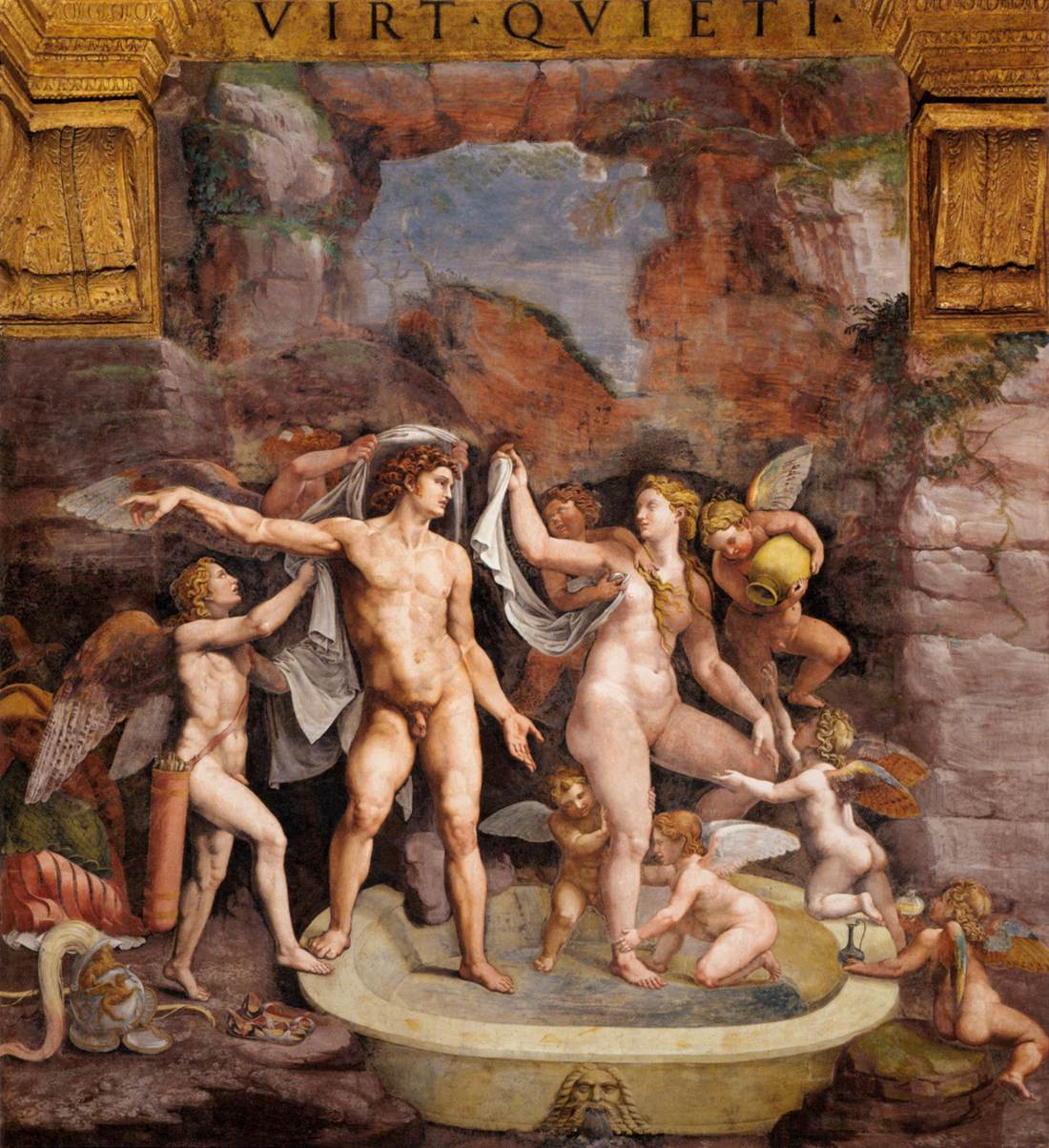
The blockbuster movie "Sex and the City" contains an accidental 'cameo appearance' of one of the frescoes by Giulio Romano, from Palazzo Te in Mantua. A detail of the "Bath of Mars and Venus", in fact, appears in the scene of the rehearsal dinner. The set of the movie scene is the restaurant Buddakan, in New York. In one of its rooms, a big replica of this fresco is hanging. You can recognize it behind Miranda, when Samantha tells her about the arrival of Steve.
Clearly, this is not an intentional homage: actually the replica of the fresco belongs to the forniture of the Buddakan. But, anyway, the sensual art of Giulio Romano has a strong connection with the sexy topics of "Sex and the City". And - sure - Giulio Romano would be very happy, knowing his works of art are still so sensual even after centuries!
VisitMantua offers you a privileged view of some of the most stunning nudes from the frescoes by Giulio... enjoy the show!
Il film campione d'incassi "Sex and the City", contiene un 'cammeo' di uno degli affreschi di Giulio Romano, da Palazzo Te, Mantova. Un particolare del "Bagno di Marte e Venere", infatti, appare nella scena della ‘Cena della prova’. La scena è ambientata nel ristorante Buddakan di New York, dove, in una delle stanze, è appesa una grande replica di questo affresco. La si può riconoscere dietro a Miranda, nella scena in cui Samantha la informa dell'arrivo di Steve.
Chiaramente non si tratta di omaggio intenzionale: la replica della affresco, infatti, fa parte degli usuali arredi del Buddakan. Ma, comunque, l'arte sensuale di Giulio Romano ha un forte legame con i temi piccanti di "Sex and the City". E - certo - Giulio sarebbe molto contento, nel sapere che le sue opere d'arte, anche dopo secoli, sono ancora così sensuali!
VisitMantua vi offre una vista privilegiata di alcuni dei nudi più belli dagli affreschi di Giulio ... godetevi lo spettacolo!
The exhibition on Maria Callas has been extended for one week. People wishing to pay a visit to the exhibition set in Palazzo Te, can do it until Sunday, June 12th. The exhibition will then move to Florence. We'd love to point out at your attention another exhibition about the Divina: ‘Maria Callas and Swarovski – Jewels on Stage’, created in 2003 by Rinaldo Albanesi, Vice-President of Swarovski International at the time. It would have been wonderful, if they had come to Mantua too.
Maria Callas: A Woman, a Voice, a Myth: a rare exhibition of the great opera singer’s costumes, jewelry and memorabilia. From 1st May to 5th June 2011, the Callas’ exhibition takes place at Palazzo Te, Mantua.
On display the stage costumes worn by the Divine to play the roles of Turandot, Rosina, Violetta Valery, Tosca and Norma. And even a valuable selection of scene jewelry. Among them deserve a special mention the necklace made by Luigi Sapelli, aka Caramba (historical costume designer of the Theatre 'La Scala' in Milan) for Aida, and the stage jewelry made for La Traviata by the firm Karmer New York based on designs of Christian Dior. A wide range of evening and concert dresses (among them some of those worn during the last world tour, between 1973 and 1974). And even clothing related to privacy of Maria Callas, created mostly by Biki, Christian Dior and Yves Saint Laurent. Foremost among these the mousseline blouse in cream cotton by Yves Saint Laurent, worn by Callas on the yacht "Christina" of Aristotle Onassis. Another memorabilia related to the Callas' holidays on the "Christina " during the '60s is a collar of gold plated with a cascade of pearls and matching earrings.
In the marvellous Sala dei Giganti of the Palazzo Te, is displayed the costume used by Placido Domingo in Rigoletto, staged in Mantua in a worldwide telecast production (2010). The costume is exhibited togheter with the jester’s stick donated by Tito Gobbi to Maria Callas in 1955 and used in the first ever production of Rigoletto, at La Fenice in 1851. Don't miss the occasion to meet - at the same time! - the magnificence of the Italian Art and the memories of one of the most iconic voices in the History of Opera. So contact us and make your guided tour a visit to be remembered!
Maria Callas: una donna, una voce, un mito: l'esposizione dedicata a costumi, gioielli e oggetti appartenuti alla grande cantante d'Opera è allestita a Palazzo Te, Mantova, dal 1 Maggio al 5 giugno 2011.
In mostra i costumi di scena indossati dalla Divina per vestire i panni di Turandot, Rosina, Violetta Valery, Tosca e Norma. E ancora una selezione di preziosi gioielli di scena. Tra questi meritano una menzione speciale la collana realizzata da Luigi Sapelli, in arte Caramba (storico costumista del Teatro 'La Scala' di Milano) per l'Aida, e i gioielli di scena realizzati per La Traviata dalla ditta Karmer New York su disegni di Christian Dior.
E ancora un'ampia scelta di abiti da sera e da concerto (tra i quali alcuni di quelli indossati durante l'ultimo tour mondiale, tra il 1973 e 1974). E anche abiti legati alla vita privata di Maria Callas, realizzati per lo più da Biki, Christian Dior e Yves Saint Laurent. Primo fra questi la camicetta in mussola di cotone color crema di Yves Saint Laurent, indossato da Maria Callas sullo yacht "Christina" di Aristotele Onassis. Un altro cimelio legato alle vacanze della Callas sul "Christina" durante gli anni '60 è una collana in metallo dorato con una cascata di perle e orecchini coordinati.
Nella splendida Sala dei Giganti di Palazzo Te, è invece esposto il costume utilizzato da Placido Domingo nel Rigoletto, trasmesso in diretta in mondovisione da Mantova nel 2010. Insieme al costume è esposto il bastone del giullare donato da Tito Gobbi a Maria Callas nel 1955, e utilizzato per la prima assoluta del Rigoletto, alla Fenice, nel 1851.
Non perdete l'occasione di incontrare - al tempo stesso! - la magnificenza dell'arte italiana ed il ricordo di una delle voci più rappresentative della storia dell'Opera. Contattateci e rendete la vostra visita guidata un'esperienza da ricordare!
The largest room of the Palazzo Te - the only whom ancient sources define "hall" instead of "chamber" - celebrates in its decoration the horses once belonging to Federico II Gonzaga, lord of Mantua and owner of the building.
The presence of these animals is very significant: according to Giorgio Vasari, Giulio Romano built the Palazzo in "a place with some stables, called the Te, standing in the middle of a meadow, in which he [Federico] kept his stud of horses and mares".
Vasari informs us also that the construction work has been carried out "without destroying the old walls".
Recent surveys have shown how actually the entire north wing of the Te, where the Hall of the Horses is, is the result of the reworking of an existing structure. So the frescoes designed by Giulio Romano celebrate the previous 'inhabitants' of this space.
Painted on the walls of the room six magnificent thoroughbred horses, large almost natural, are proudly displayed. Some of them with well known names: Morel Favorito (i.e. "Black Favorite") and Dario ("Darius") are in fact still accompanied by inscriptions recalling the identity. For two other horses - Glorioso and Battaglia (i.e. "Glorious" and "Battle") - the names are preserved in sixteenth-century engravings, which show the ancient features of the room. The names of the remaining two horses are still unknown.
Wish to know more? Contact us, come to Mantua and discover, through our professional services, stories, places and artistic treasures, like this one.
L’ambiente più ampio di Palazzo Te, l’unico definito nelle fonti ‘sala’ e non ‘camera’, celebra nel suo apparato decorativo i cavalli appartenuti a Federico II Gonzaga, Signore di Mantova e committente del Palazzo. La presenza di questi animali è assai significativa: a detta di Giorgio Vasari, Giulio Romano avrebbe infatti realizzato Palazzo Te in un “luogo e certe stalle […] dove [Federico] teneva la razza de’ suoi cavalli e cavalle”. Il Vasari ci informa anche di come tale opera di costruzione sarebbe stata eseguita “senza guastare la muraglia vecchia”. Recenti indagini hanno comprovato come effettivamente l’intera ala nord del Te, ove si trova la sala in questione, sia frutto del rimaneggiamento di una struttura preesistente. Gli affreschi progettati da Giulio Romano in questo ambiente celebrano quindi in immagine, i precedenti ‘padroni di casa’.
Sulle pareti affrescate della sala sei magnifici destrieri, grandi quasi al naturale, fanno bella mostra di sé. Di alcuni si conoscono anche i nomi: Morel Favorito e Dario sono infatti ancora accompagnati dalla scritta che ne ricorda l’identità. Per altri due cavalli – Glorioso e Battaglia – i nomi sono invece conservati in testimonianze grafiche cinquecentesche che riproducono l’aspetto della sala. Gli appellativi dei restanti due destrieri restano ancora ignoti.
Volete saperne di più? Venite a Mantova e contattateci, per scoprire, attraverso i nostri servizi professionali, storie, luogi e tesori dell'arte come questi.
On view stage costumes, dresses, memorabilia, and archival photos collected over years of passionate research by Bruno Tosi, President of Associazione Culturale Maria Callas. First displayed at the Olivetti Show Room in Venice in 1993, this exhibition has successfully toured around the world. Following shows at the Italian Cultural Institutes of Los Angeles and San Francisco, the exhibition has now been extensively enlarged and updated and is now on view at the Italian Cultural Institute of New York. Then the exhibition will come back to Italy: from April 15th, in fact, the spirit of La Divina will inhabit the Renaissance rooms of Palazzo Te, Mantua.
Don't miss the occasion to meet - at the same time! - the magnificence of the Italian Art and the memories of one of the most iconic voices in the History of Opera. Socontact us and make your guided tour a visit to be remembered!
The inscription running around the walls of the chamber of Cupid and Psyche (or Eros and Psyche) in Palazzo Te says that Federico Gonzaga, lord of Mantua, “ordered its construction for his honest leisure after hard work to regain his strength in peace”.
What kind of “honest leisure”? Well, this detail of the frescos painted by Giulio Romano can answer the question. Among the amorous-themed paintings in the room, this one has been treated with an extraordinary boldness, reflecting the flaming passion for sexual pleasure, which marked the behaviors of Federico Gonzaga. The scene shows the king of gods Jupiter entering – disguised as a snake – into the bed of Olympias, queen of Macedonia. According the legend, in consequence of this intercourse the Queen gave birth to Alexander the Great. The scene is forthrightly pornographic. But the fresco is also referring to a biographical aspect of Federico's life: the lord of Mantua had a child from his mistress, Isabella Boschetti, who used to live in this Palace. And this son was named Alexander. Want to know more? Contact us and discover through our professional services the people, the stories and the art, who have made Mantua one of the capitals of the Renaissance.
L'iscrizione che corre sulle pareti della camera di Amore e Psiche a Palazzo Te dichara che Federico Gonzaga, signore di Mantova, "ne ordinò la costruzione per l'onesto ozio, al fine di ritemprare la forze nella quiete dopo le fatiche".
Che tipo di "onesto ozio"? Beh, questo dettaglio degli affreschi dipinti da Giulio Romano può rispondere alla domanda.
Tra i dipinti a tema amoroso della stanza, questo è stato trattato con un’incredibile audacia, che riflette la passione ardente per i piaceri della carne, che tanto ha segnato i comportamenti di Federico Gonzaga.
La scena mostra Giove, il re degli dei, mentre – mutatosi in serpente – entra nel letto di Olimpia, regina di Macedonia. Secondo la leggenda, in conseguenza di questo rapporto, la regina diede alla luce Alessandro Magno.
La scena è senza mezzi termini pornografica. Ma l'affresco è anche riferimento ad un aspetto biografico della vita di Federico: il signore di Mantova ebbe infatti un figlio dalla sua amante, Isabella Boschetti, che viveva in questo palazzo. E a questo figlio fu dato il nome Alessandro.
Volete saperne di più? Contattateci e scoprite attraverso i nostri servizi professionali le persone, le storie e i tesori dell'arte, che hanno fatto di Mantova una delle capitali del Rinascimento.